Enterprise Job Portal
Problem. The brief called for a two-sided recruitment marketplace able to stand alongside large, established job marketplaces, not a scoped-down job board with a handful of screens.
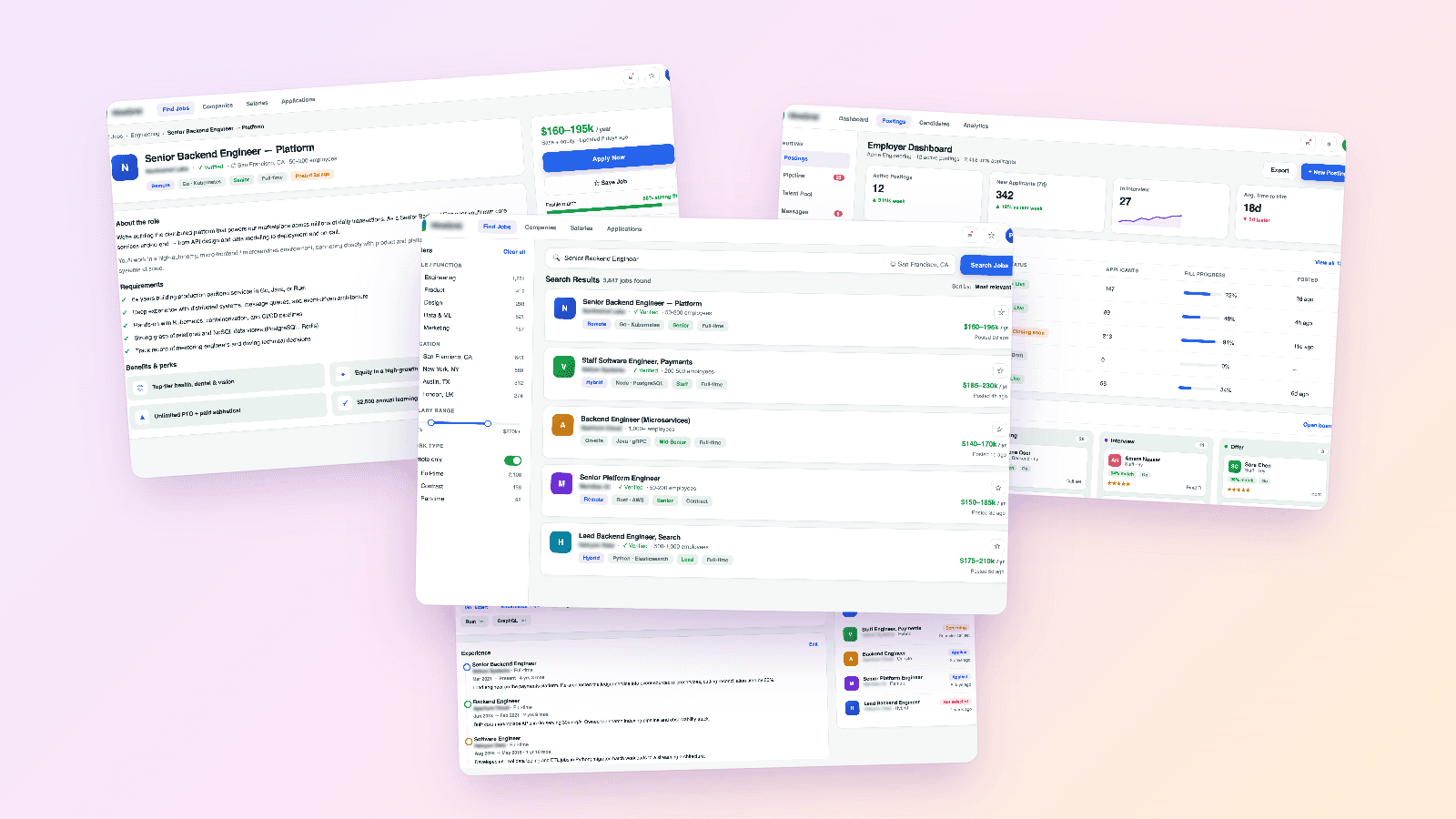
What we built. A full-scale job portal connecting employers and candidates, built end-to-end as independently deployable microservices and micro-frontends so it can grow with multiple teams.
The brief was to build a complete job portal capable of standing alongside large, established recruitment marketplaces: a platform that could sit employers and candidates side by side and support the full lifecycle of listing, discovering, and applying for work on a single system. That ambition set the bar for the engineering approach from the outset: this was not a scoped-down job board with a handful of screens, but a two-sided marketplace expected to carry the volume, breadth, and reliability associated with the category's largest players.
A platform operating at that scale has to absorb a constant, high-volume stream of listings, applications, and searches without any one of the three degrading the others: employers posting and managing openings, candidates searching and applying, and the underlying data growing continuously across all of it. Just as important, the system had to stay maintainable as both its feature set and the team building it grew over time. A platform sized for a recruitment marketplace is not built once and left alone; it is extended continuously, and the codebase and architecture need to absorb that ongoing growth without becoming harder to work in as they do.
The natural risk in a project of this shape is architectural: a traditional monolith (one codebase, one deployment, one release train) becomes a bottleneck precisely at the scale this platform was aimed at. Every team's changes would compete for the same deployment window, every release would carry the risk of every other team's changes, and scaling the system under load would mean scaling the entire application even when only one part of it (search, say, or applications) was under pressure. Recognizing that risk up front, the platform was designed from day one for independent, parallel development, so that deployment velocity and the ability to scale would not be constrained by the shape of a single, shared codebase.
Two-Sided Marketplace
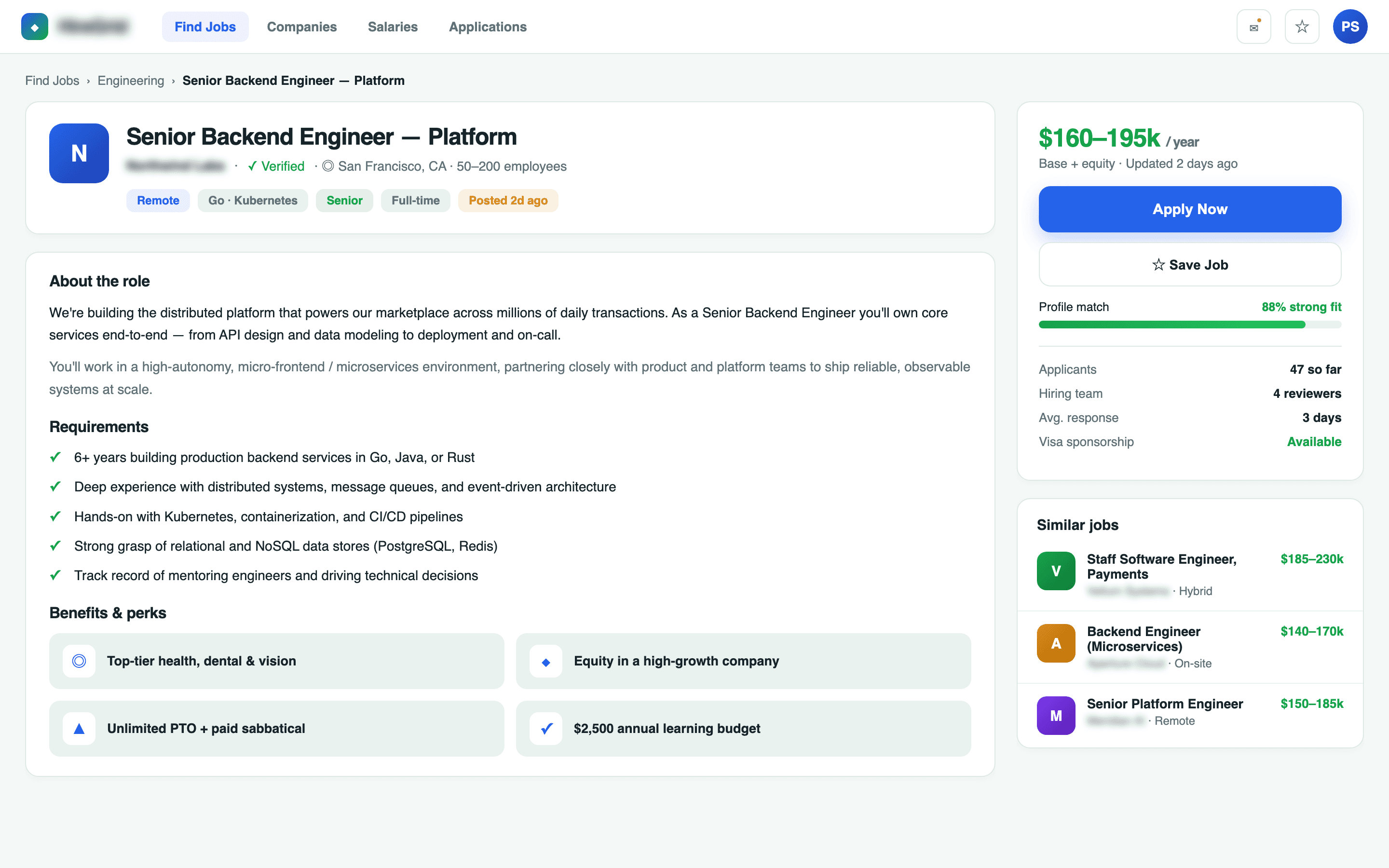
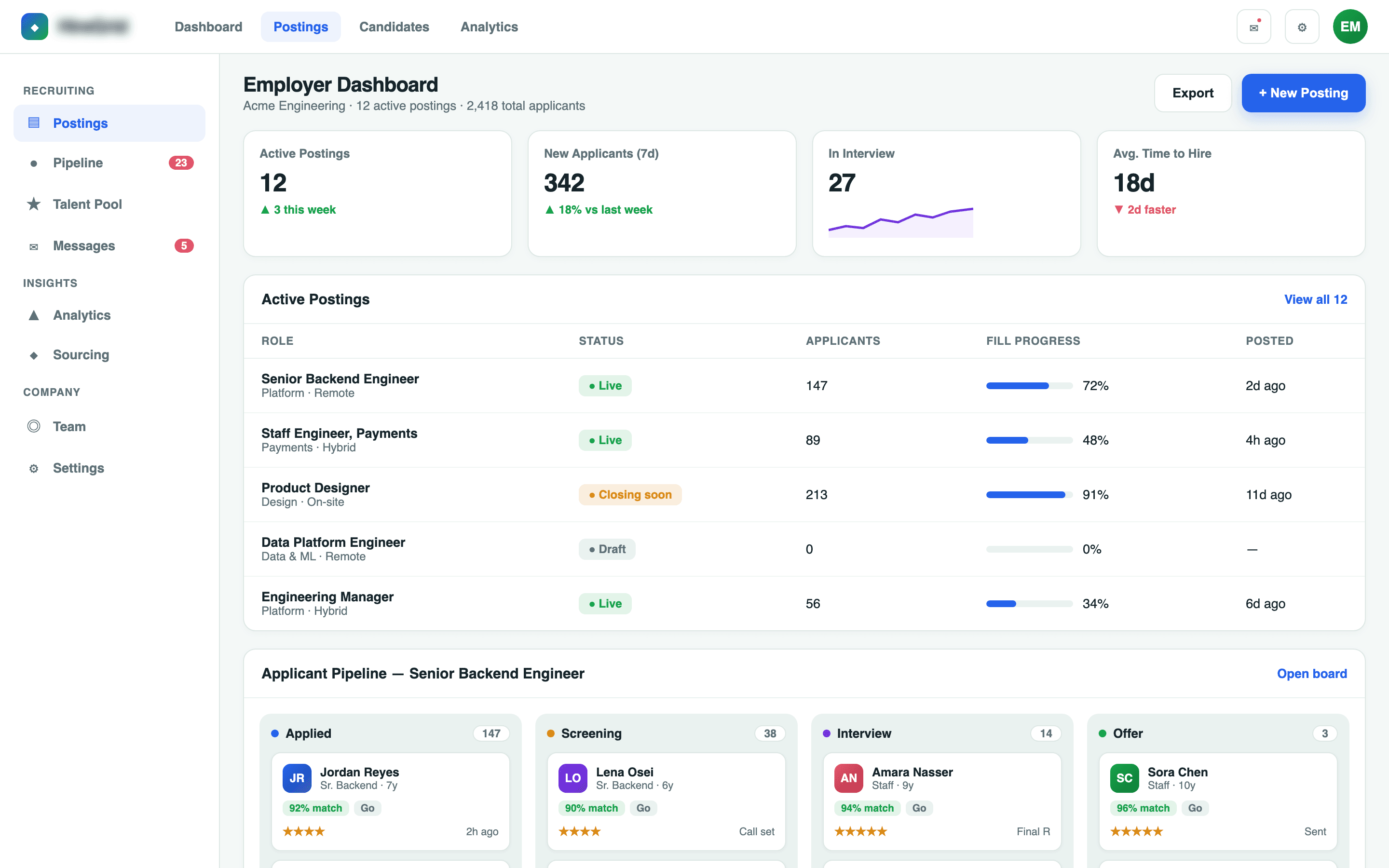
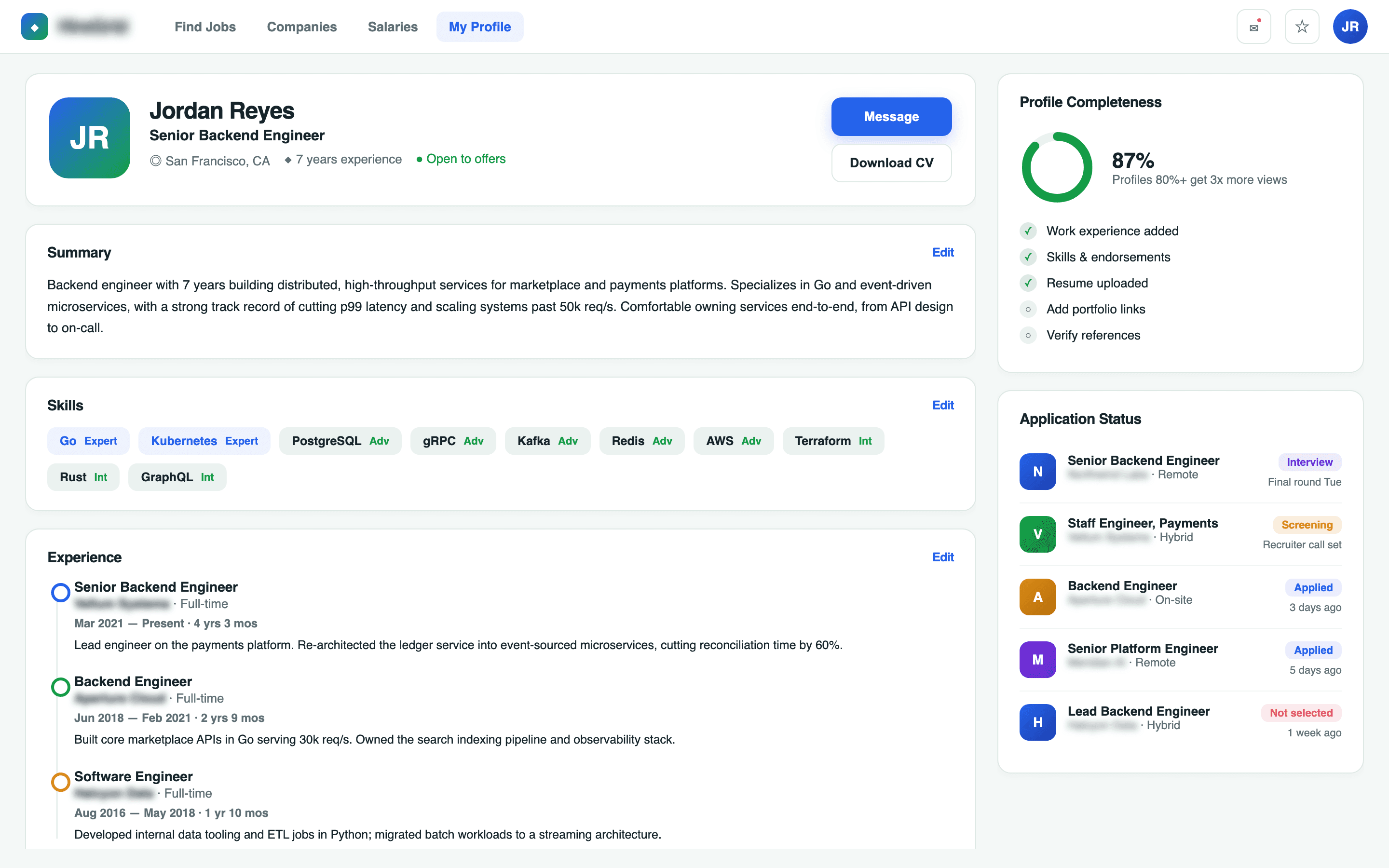
Serves both employers (posting, applicant tracking) and candidates (search, profiles, applications) on one platform.
Domain-Driven Microservices
Core domains (accounts, jobs, applications, search, notifications) split into independently deployable services.
Micro-Frontend Architecture
Distinct sections of the product ship independently, letting separate teams own end-to-end product slices.
End-to-End Hiring Workflow
Job posting, discovery, and application flows powering the core marketplace loop.
Scalable Data Layer
Built for large catalogs and high-volume search and application traffic.
The architecture was built around one governing decision: break the platform into independently deployable pieces along the same lines the business itself was organized, so that scale and team growth would be assets rather than liabilities.
- The platform was decomposed by business domain into a set of independently deployable services, with boundaries drawn along the same lines the business itself was organized rather than around arbitrary technical layers. This meant a change to, say, the employer-listing area could be built, tested, and shipped without triggering a redeploy of the candidate-search area or any other part of the system. The trade-off was accepting the added coordination of running and communicating between multiple services in place of the simplicity of one shared codebase: a cost accepted because it directly removed the single-deploy bottleneck the project was designed to avoid.
- On the frontend, the team adopted a micro-frontend architecture that mirrored the same domain boundaries used on the backend, rather than a single unified frontend application talking to many backend services underneath it. That symmetry meant a team could own its slice of the product end-to-end (the backend service and the frontend surface built on top of it) instead of handing work off across a boundary between separate frontend and backend teams. Owning a full vertical slice let a team ship a feature independently, without waiting on, or blocking, the teams responsible for other parts of the product.
- Because the platform was now made up of multiple independently deployable services and frontends rather than one application, how those pieces talked to each other became a first-class design concern in its own right. Service-to-service communication and clear contracts between teams were designed deliberately, so that each deployable unit could change internally without breaking the units around it, keeping the pieces loosely coupled rather than accidentally re-creating monolith-style interdependency inside a distributed system. Without that discipline, splitting the platform into services would have simply relocated the coupling problem instead of solving it.
- The data layer was built to scale horizontally rather than by relying on a single, ever-larger database instance, with particular attention paid to isolating the platform's highest-traffic paths (search and applications) from the rest of the system. Isolating those paths meant the parts of the platform under the heaviest and most variable load could be scaled on their own terms, without over-provisioning the rest of the system to match. This mirrored the same philosophy applied to the services and frontends above it: the pieces under the most pressure should be able to grow independently of the pieces that are not.
- The engagement delivered a large-scale, two-sided marketplace connecting employers and candidates, built end-to-end from a set of independently deployable services and independently deployable frontends rather than a single unified application. That structure meant the finished platform matched the scale ambition set out at the start of the project (a system on par with large recruitment marketplaces) while also matching that ambition with an architecture actually capable of supporting it as it grows.
- The single-deploy bottleneck that a traditional monolith would have imposed was removed entirely, because no team's release depended on shipping alongside every other team's changes. In practice, that meant multiple teams could build and release their own areas of the platform in parallel, each on its own schedule, rather than queuing behind a shared release train the way they would have on a monolithic codebase. That change in release model was the direct payoff of decomposing the platform by domain from the outset rather than retrofitting the split in later.
- Because the services, frontends, and data layer were all built with independent scaling in mind, the platform now has clear paths to scale as listing, search, and application volumes grow, rather than facing a rearchitecture to handle that growth later. The highest-traffic paths (search and applications) can be scaled on their own as load increases there specifically, without needing to scale the entire platform to match. That leaves the platform room to grow with the business rather than requiring a second, disruptive redesign once the current architecture is outgrown.
Discovery
Understand the problem, the users, and the real constraints before any design work starts.
Design
Architecture and UX decisions made deliberately, before a line of production code is written.
Build
Iterative development with regular check-ins, so direction can be corrected early and cheaply.
Test
QA and hardening against real-world edge cases before anything reaches production.
Ship & Support
Launch, then stay involved: monitoring, fixes, and iteration as the product keeps growing.